
Wouldn't it be wonderful to visit the Yorkshire Dales? Yes, we thought so too, so let's travel along another beautiful road in England and venture to a very beautiful area. Even though we are staying in the Lake District, the Yorkshire Dales are just next door. This beautiful area is full of river valleys and hills. It is in the northern section of England in the Pennines. The U and V shaped valleys were formed by the ice age. Dry stone walls dot the bucolic sheep and cattle pastures.

We have a beautiful day to explore this lovely area. Don't worry about snow as it's still September and it won't come for a couple months now!

I must admit I have taken so many photos it is difficult to not post them all! I'm sure I would lose you, so I will try very hard not to post too many.

We are traveling along the roads on our way to a very special castle. It's quite ancient and most of it is in ruins, but very interesting.

The Yorkshire Dales are lush and green as is most of England. The frequent rain rewards us with beautiful sights!


The underlying rock is limestone and shale. I love seeing the many walls constructed so long ago.


As lovely as the purple loosestrife is, it's an invasive plant in the US and I assume it is in England as well. We saw quite a bit of it all over. This invasive plant was brought over to North America in the ballasts of ships in the 1800's. The problem is the plant can degrade the wetlands and mess with the natural habitat that lives there.

Riding along we are treated to one lovely sight after the other.

Riding along we are treated to one lovely sight after the other.
 |
| Garsdale Head Viaduct |

There are many beautiful stone bridges and viaducts as we are traveling along the country roads. Some are ancient, but still in use.


Around every bend there are surprises.

Here is our first glimpse of Castle Bolton! There she stands proudly as she has for over 600 years. She was the home of Sir Richard Le Scroupe. He was the Lord Treasurer and Lord Chancellor to Richard II. Historians suggest he was "the perfect and gentle knight" described in Chaucer's, Canterbury Tales. Castle Bolton has a fascinating history. Come along and we'll go inside.


This is the view from the castle car park! Can you believe its beauty?

Saint Oswald Church is right next to Castle Bolton.

The church dates back to the 14th century with a congregation still today.

Walking into the castle entrance that takes you through a tearoom, I spy the largest bag of tea I've ever seen!

It's quite chilly in this old castle, so I can just imagine there are many takers for tea here today!
After checking in we receive a map and begin to explore the ruins of Castle Bolton. As you can tell a castle is really a small city into itself. We learn that the castle would have been more fine than any 21st century hotel.

The wind is whipping around all of the old ruins, so we'll explore all bundled in our coats.
Castle Bolton was in its heyday until 1536 when it was fired by King Henry VIII because he disapproved of Sir John, 8th Baron Scropes for his non support during the Pilgrimage of Grace. Then one hundred years later it suffered an attack by Parliamentarian forces for 6 months during the Civil War. The Castle was "slighted" (meaning a partial destruction) by Cromwell's men in 1647 after being held by parliament for two years. In 1761 the North East Tower collapsed during a storm. It was not until the turn of the 21st century that conservation work was completed and allowed visitors to Castle Bolton.
Going inside we visit an interesting hall that has dried flowers and herbs used for what ails may befall you.


Stepping into the center we see the ancient walls of the castle.


You can see that this Castle was enormous.


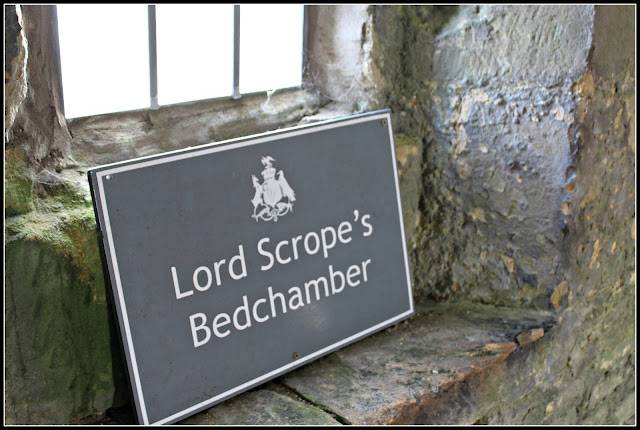
Let's climb the tower and see some of the bed chambers.

On the way we pass through many great halls.


On the way there are many amazing views from the castle.

Mary Queen of Scots stayed in this bed chamber during her imprisonment after the Battle of Langside was lost. She was moved here by Elizabeth I. She brought along with her many servants. Some of them stayed here at the castle and some in the surrounding area.

She was allowed to go about the grounds and hunt. She studied English as she spoke French and Scots (a variety of English) when she came to Castle Bolton.



You can view the lovely gardens that surround the castle. It is believed that Castle Bolton did not have a moat.


Driving along the lane, leaving Castle Bolton, we see the most interesting carving of a dragon. How fitting for our trip to this Medieval Castle!

It was carved by chainsaw by a local artist, Andris Bergs, from a fallen ash tree. Notice the dragon appears to have finished off a brave knight!

Here is our first glimpse of Castle Bolton! There she stands proudly as she has for over 600 years. She was the home of Sir Richard Le Scroupe. He was the Lord Treasurer and Lord Chancellor to Richard II. Historians suggest he was "the perfect and gentle knight" described in Chaucer's, Canterbury Tales. Castle Bolton has a fascinating history. Come along and we'll go inside.


This is the view from the castle car park! Can you believe its beauty?

Saint Oswald Church is right next to Castle Bolton.

The church dates back to the 14th century with a congregation still today.

Walking into the castle entrance that takes you through a tearoom, I spy the largest bag of tea I've ever seen!

It's quite chilly in this old castle, so I can just imagine there are many takers for tea here today!
After checking in we receive a map and begin to explore the ruins of Castle Bolton. As you can tell a castle is really a small city into itself. We learn that the castle would have been more fine than any 21st century hotel.

The wind is whipping around all of the old ruins, so we'll explore all bundled in our coats.
Castle Bolton was in its heyday until 1536 when it was fired by King Henry VIII because he disapproved of Sir John, 8th Baron Scropes for his non support during the Pilgrimage of Grace. Then one hundred years later it suffered an attack by Parliamentarian forces for 6 months during the Civil War. The Castle was "slighted" (meaning a partial destruction) by Cromwell's men in 1647 after being held by parliament for two years. In 1761 the North East Tower collapsed during a storm. It was not until the turn of the 21st century that conservation work was completed and allowed visitors to Castle Bolton.
Going inside we visit an interesting hall that has dried flowers and herbs used for what ails may befall you.


Stepping into the center we see the ancient walls of the castle.


You can see that this Castle was enormous.


Let's climb the tower and see some of the bed chambers.

On the way we pass through many great halls.


On the way there are many amazing views from the castle.

Mary Queen of Scots stayed in this bed chamber during her imprisonment after the Battle of Langside was lost. She was moved here by Elizabeth I. She brought along with her many servants. Some of them stayed here at the castle and some in the surrounding area.

She was allowed to go about the grounds and hunt. She studied English as she spoke French and Scots (a variety of English) when she came to Castle Bolton.


You can view the lovely gardens that surround the castle. It is believed that Castle Bolton did not have a moat.


Driving along the lane, leaving Castle Bolton, we see the most interesting carving of a dragon. How fitting for our trip to this Medieval Castle!

It was carved by chainsaw by a local artist, Andris Bergs, from a fallen ash tree. Notice the dragon appears to have finished off a brave knight!
